

What this tab is for
- See whether a cheaper routed model stays “good enough” for your prompts.
- See cost and latency savings when routing applies.
- Keep a short history of runs (with delete) for demos or regression checks.
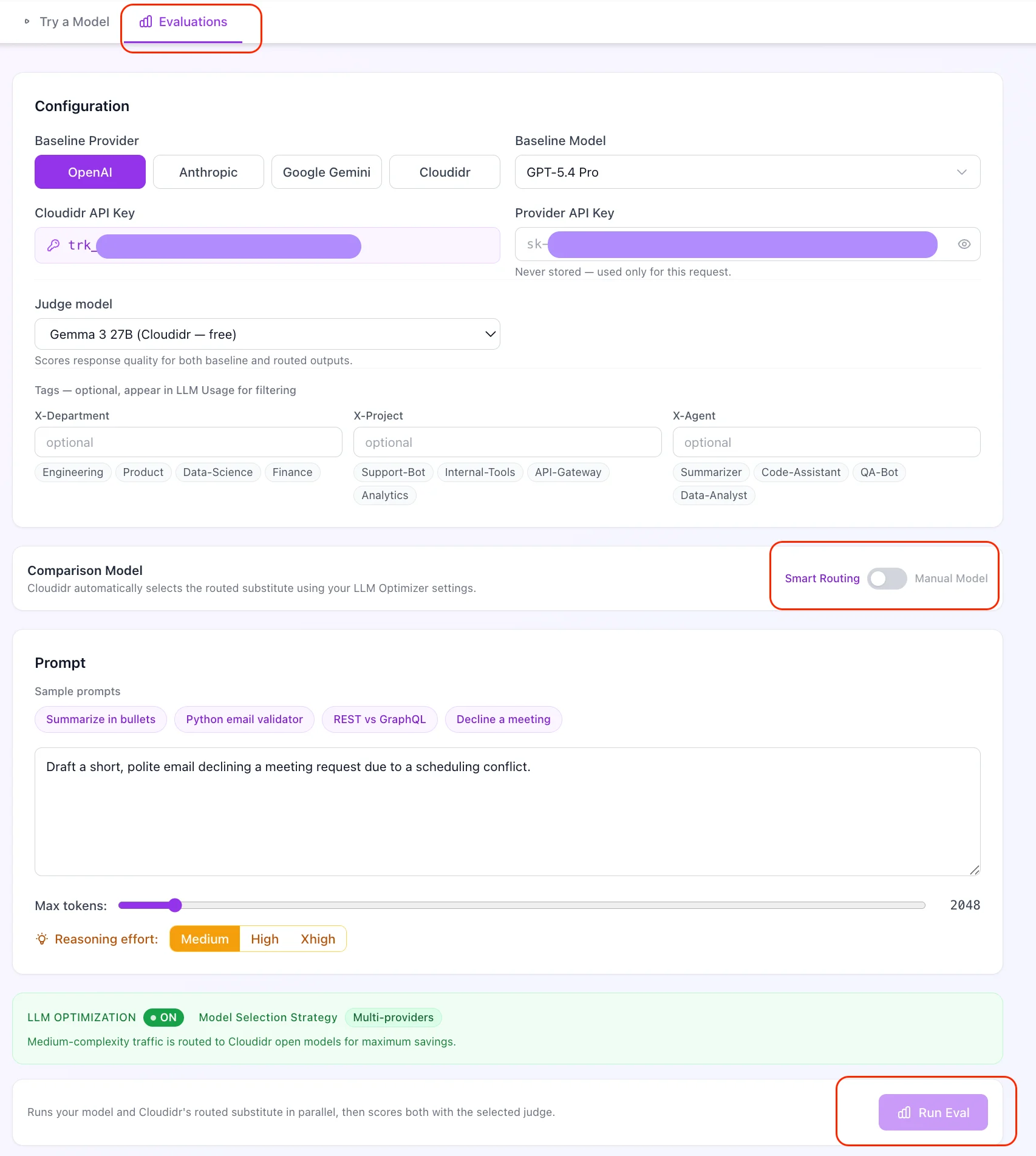
| Mode | Description |
|---|---|
| Smart Routing | Cloudidr automatically picks the comparison model based on your routing strategy. Requires LLM Optimization to be on. |
| Manual Model Comparison | You choose both the baseline and comparison models from any provider. Useful for evaluating specific model pairs independently of routing. |
LLM Optimization status — required for Smart Routing
A status card shows whether LLM Optimization is on and which strategy applies (e.g. Intra Provider vs Flexible).Important: If Model Routing is off, Run Eval is disabled in Smart Routing mode — there is no routed path to compare. Turn optimization on under LLM Optimizer Settings, or switch to Manual Model Comparison mode.
Configuration
- Baseline model — same model picker as Try a Model.
- Comparison model — in Manual mode, you pick this yourself from any provider. In Smart Routing mode, Cloudidr selects it automatically.
- Judge model — pick who scores the two answers:
- Cloudidr (free): Gemma 3 27B or Qwen 3.5 27B or similar model is used — no API key needed.
- Your provider key: top-tier options per provider, for example:
- OpenAI: GPT-5.5 Pro / GPT-5.5 / GPT-5.4
- Anthropic: Claude Opus 4.6 / Claude Sonnet 4.6
- Google: Gemini 3.1 Pro / Gemini 2.5 Flash
Run Eval
Runs both models in parallel, then runs the judge. Results appear side by side; savings percentage and verdict show below.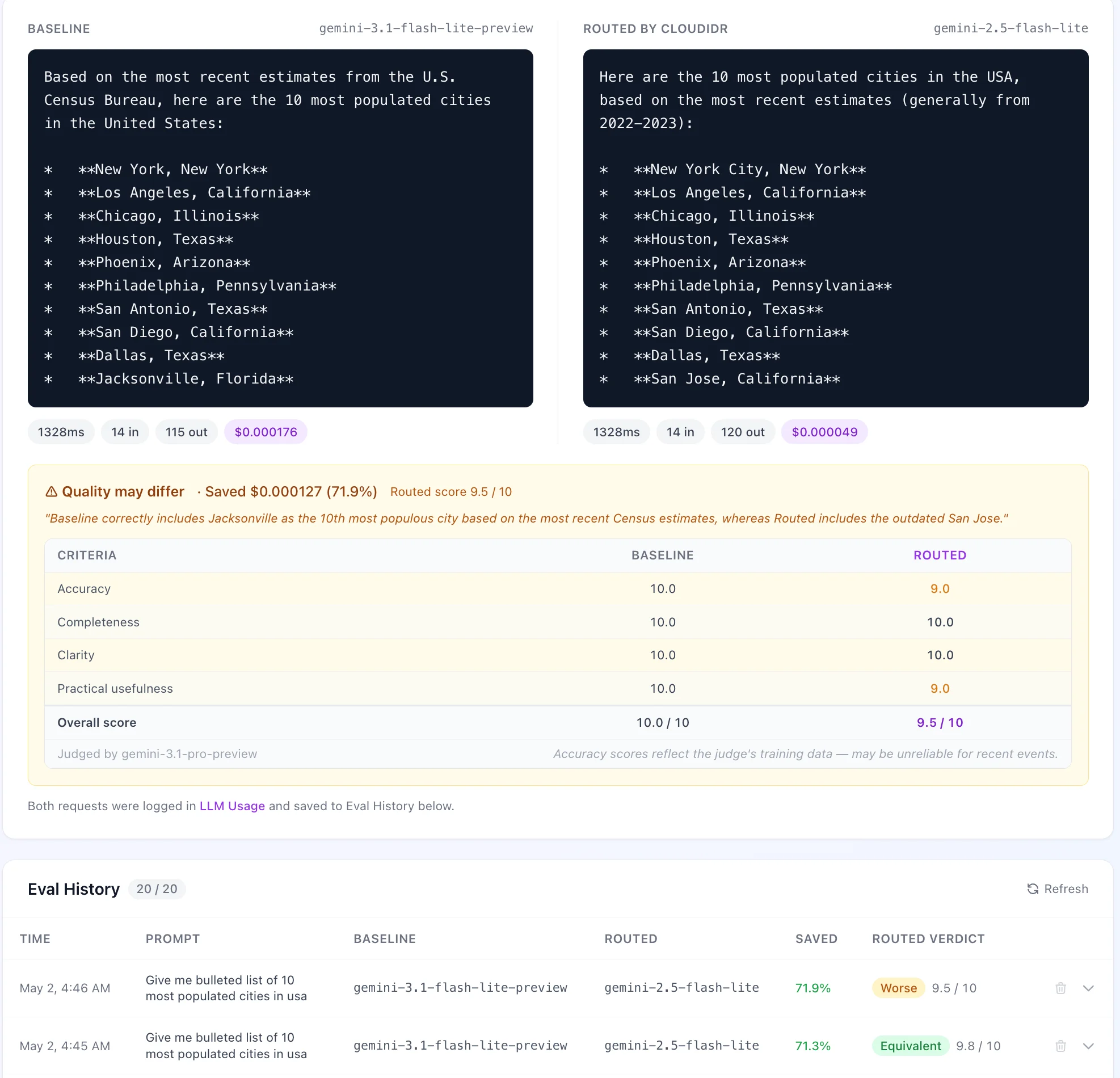
When routing does not apply — Smart Routing mode only
The UI explains two cases where no routing substitute is used:- Recency protection — the prompt matched recency signals; Cloudidr keeps the baseline model. You can turn Recency protection off under Optimizer Settings if you accept routing for those prompts.
- Complex / no substitute — the prompt is classified as too complex for routing, or no cheaper mapped model exists. Flexible routing does not override the “complex” classification; simplifying the prompt is the practical path.
Verdict and scores
- Verdict — whether the comparison answer is Better, Equivalent, or Worse (derived from the score delta), or No routing / Too complex to route in Smart Routing mode.
- Score — overall 1–10 score with a criteria breakdown (Accuracy, Completeness, Clarity, Practical usefulness) when the judge returns structured axes.
- If the judge fails (API error, parse error), an explicit error message is shown instead of silent neutral scores.
Eval History
Table of recent runs showing: time, prompt snippet, models used, savings percentage, verdict, and score. Expand any row for the full responses, judge reasoning, and criteria breakdown.- Delete removes a single run (with confirmation).
- Bulk delete — select multiple rows with the checkboxes and delete them all at once.
- At most 20 runs per organization are kept — the oldest run is trimmed automatically when a new one is inserted.